Growing Up The Hard Way: What IT Admins Need to Know

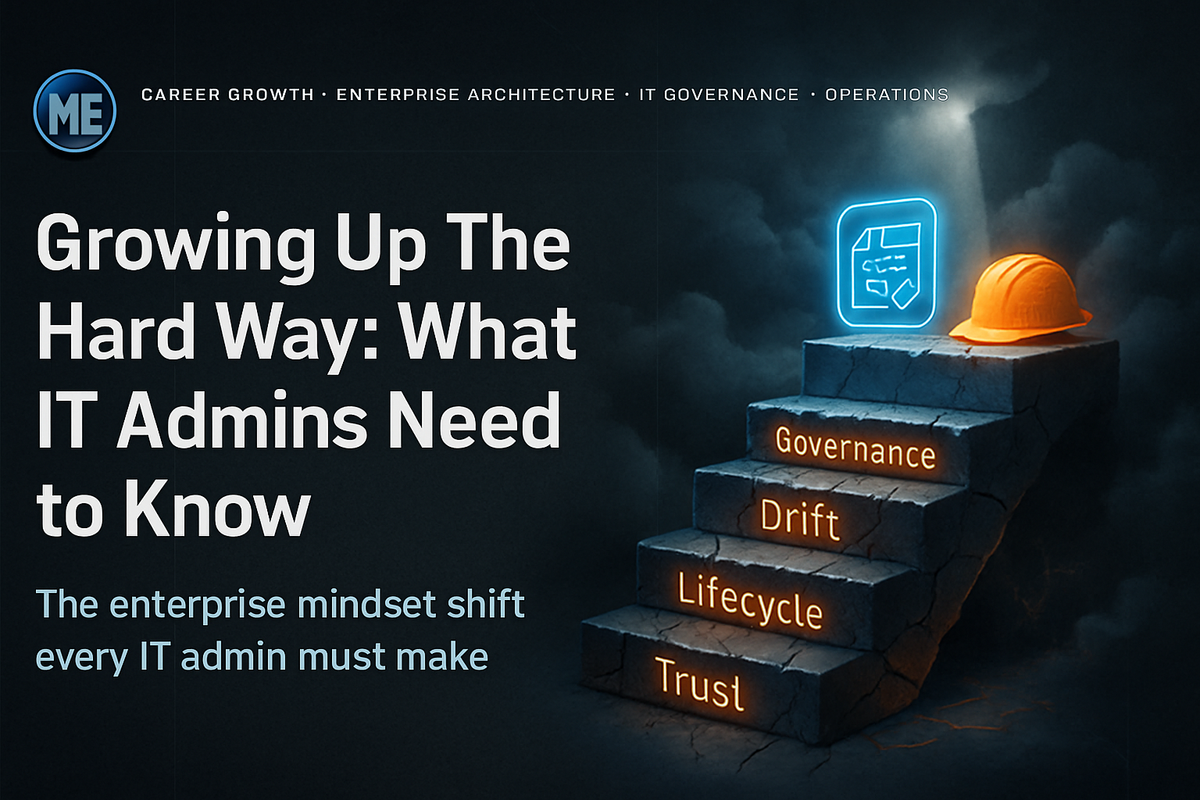
Growing Up The Hard Way: What IT Admins Need to Know
I've sat in too many architecture reviews where someone slides a bill of materials past me and every third component is an open source library nobody has reviewed in two years. Not because anyone made a bad decision. Because nobody made any decision at all. The library just arrived, embedded inside something else, inside something else again, and now it lives in production the way old furniture lives in a house: you stop seeing it.
🔍 The Childhood Is Over
Open source had a genuinely good run. For two decades it operated on trust, goodwill, and the assumption that visibility equals security. The logic was not unreasonable: if anyone can read the code, someone will catch the problems. And for a long time, that was close enough to true that nobody got fired for believing it.
Then the threat model changed. Not gradually. It cracked open all at once.
SolarWinds, Log4Shell, then a cascade of supply chain compromises that made those look like isolated incidents rather than signals of a structural problem. The source material frames this perfectly: the supply chain "woke up one morning like the end of Ender's Game: the simulation had been real the whole time." Those weren't practice rounds. Real infrastructure, real data, real business continuity, all of it quietly load-bearing on code nobody had formally accepted responsibility for.
What the source material calls "the adults showing up with rules" is not hyperbole. Executive orders, the EU Cyber Resilience Act, CISA guidance on software bill of materials requirements - these are direct responses to the realization that the open source ecosystem was running critical infrastructure with no chain of custody. IT admins who have been ignoring this governance layer are about to find it is no longer optional.
⚠️ The Two-Front War Nobody Briefed You On
The framing I keep returning to from the source article is the pincer movement. AI-accelerated vulnerability discovery on one side, industrialized malware delivery through poisoned distribution channels on the other.
This is not an abstract threat model. This is the operational environment your organization is in right now.
AI-assisted tooling is finding novel, chained zero-days faster than traditional triage processes can absorb. I've watched security teams operate with a mean time to patch that was designed for a world where researchers discovered vulnerabilities at human speed. That world is gone. The discovery rate has changed. The triage model has not.
On the delivery side, dependency confusion attacks and typosquatting campaigns have turned package registries into active threat surfaces. This is not theoretical. Packages with malicious payloads have been downloaded millions of times from PyPI and npm before being identified. Your developers are not doing anything wrong. The distribution channel itself is the attack vector.
🧩 What This Actually Means for IT Admins
Here is where I want to be direct, because a lot of the supply chain security conversation stays at the DevSecOps and developer tooling layer and never reaches the people managing endpoints, identities, and the Microsoft 365 environment.
That gap is a mistake.
Software Bill of Materials (SBOM) requirements are moving from federal contractor obligation to enterprise baseline expectation. If you manage an endpoint fleet, you need to understand what is installed on those endpoints at the component level, not just the application level. The Intune hardware inventory and software inventory models were not designed for this. They tell you Excel is installed. They do not tell you which version of OpenSSL is bundled inside the PDF reader your finance team is using.
Microsoft Defender Vulnerability Management is closing part of this gap. The application inventory and browser extension discovery capabilities inside the Defender portal give you more signal than traditional endpoint management did. But signal is not governance. Knowing a vulnerable library exists and having an organizational decision about what to do about it are different problems.
See: https://learn.microsoft.com/en-us/defender-vulnerability-management/tvm-software-inventory
🚫 What This Technology Does NOT Solve
I want to be careful here, because the natural response to everything I've described is to reach for tools. SBOM tooling, software composition analysis, supply chain security platforms. These are real and useful. They are not sufficient.
Tooling does not solve the governance deficit. You can run a full dependency graph scan and produce a beautiful SBOM that nobody has the authority to act on. I've seen this in enterprise environments repeatedly. The security team produces the artifact. The development team owns the remediation. The remediation requires a release cycle. The release cycle is owned by product management. Product management is focused on features. The vulnerability sits in the ticket queue for six months.
Visibility does not equal accountability. The open source model assumed that transparency was enough. It isn't. Transparency tells you the problem exists. Accountability determines whether it gets fixed.
Patching does not address architectural exposure. If a critical library is embedded in a commercial product you do not control, your patch timeline is the vendor's patch timeline. You can know about the vulnerability before the vendor patches it. You cannot fix it faster than they do.
AI-accelerated scanning does not replace human triage judgment. The same AI capabilities being used by attackers to find vulnerabilities faster are being built into defensive tooling. But an AI-generated finding still requires a human decision about exploitability, business context, and remediation priority. Speed of discovery without speed of decision creates noise, not security.
See also: https://learn.microsoft.com/en-us/azure/defender-for-cloud/defender-for-devops-introduction
📊 The Threat Landscape Shift in Numbers
| Threat Vector | Pre-2020 Posture | Current Reality |
|---|---|---|
| Vulnerability discovery rate | Research-paced, weeks to months | AI-assisted, hours to days |
| Supply chain compromise | Occasional, high-effort | Industrialized, automated distribution |
| Dependency attack surface | Ignored | Active exploitation target |
| Regulatory response | Voluntary guidance | Mandatory compliance (CRA, EO 14028) |
| SBOM requirement | Best practice | Contractual and regulatory obligation |
| Vendor patch timelines | Acceptable lag | Exploitability window now precedes patch |
The column on the right describes the environment your organization is operating in. The left column describes the governance model most organizations still have.
That delta is the risk.
🎯 Final Architect Recommendation
Open source is not going away. The source material is right about that. The OSI definition stands. The licensing model survives. What is changing is the contract of trust that surrounded the ecosystem for twenty years - the implicit assumption that open availability meant collective security.
That contract is void.
If I were advising an enterprise today, my recommendation would be sequenced deliberately. Do not start with tooling. Start with governance. Assign a named owner for software supply chain risk. Define what "acceptable" looks like for transitive dependencies. Establish a remediation SLA that is actually achievable given your development team's capacity. Document the exception process before you need it.
Then deploy tooling to make that governance visible and measurable.
I would not skip the accountability model in favor of faster scanning. I have seen organizations with excellent scanning and no remediation process produce nothing but an ever-growing liability register. That is not security. That is documentation of exposure without mitigation.
I would also be honest with leadership about what "growing up" costs. The open source ecosystem's childhood was cheap precisely because it externalized all of the security costs onto whoever happened to be downstream when something went wrong. Industrialized supply chain attacks have ended that model. Someone pays now. The question is whether it is the attacker's target or whether it is the organization that decided to build a governance layer before the incident.
In my experience, the organizations that handle this best are the ones that treat supply chain security as an architectural concern, not a scanning exercise. They ask: "What is our trust model for external code?" before they ask "What tool should we buy?"
AI-accelerated vulnerability discovery means that the window between public disclosure and active exploitation is collapsing. SLA frameworks built for weekly patch cycles are structurally inadequate for the current threat environment. If your vulnerability management SLAs have not been reviewed against the current threat cadence, they are likely creating a false sense of compliance coverage.
Transitive dependency attacks specifically target the gap between what your security team approved and what actually runs at build time. Organizations that rely solely on approved package lists without monitoring transitive dependency resolution at build time have a blind spot that is actively exploited. This is not a theoretical risk. It is a documented attack pattern with confirmed enterprise victims.
When implementing SBOM tooling, run your first scan against an application you know well, not your highest-risk system. The output volume from an unfamiliar application creates noise that obscures the governance conversation. Start with a known system, validate your triage process, and build the accountability model from a position of understood baseline before expanding scope.
🎯 The Takeaway
- If your vulnerability management SLAs were written before 2022, review them now. The discovery rate has changed. SLAs that were reasonable in a research-paced environment create a queuing backlog in an AI-assisted discovery environment.
- Always establish accountability before tooling. If you deploy SBOM scanning without a named owner for each dependency category, you produce a liability register, not a security control.
- If a library appears in your approved package list but your build process resolves transitive dependencies at runtime, your approval process is incomplete. Approval must extend to the resolved dependency graph, not just the direct dependency list.
- When regulatory SBOM requirements arrive in your sector, your starting position determines your compliance cost. Organizations with existing dependency governance adapt with moderate effort. Organizations starting from zero face a documentation and remediation project measured in quarters, not weeks.
- Never treat supply chain security as a scanning exercise. Scanning is detection. Governance is security. Build the accountability model, define the remediation process, and let tooling make that model visible - in that order, not the reverse.