ISC Stormcast For Friday, July 17th, 2026 https://isc.sans.edu/podcastdetail/10012…

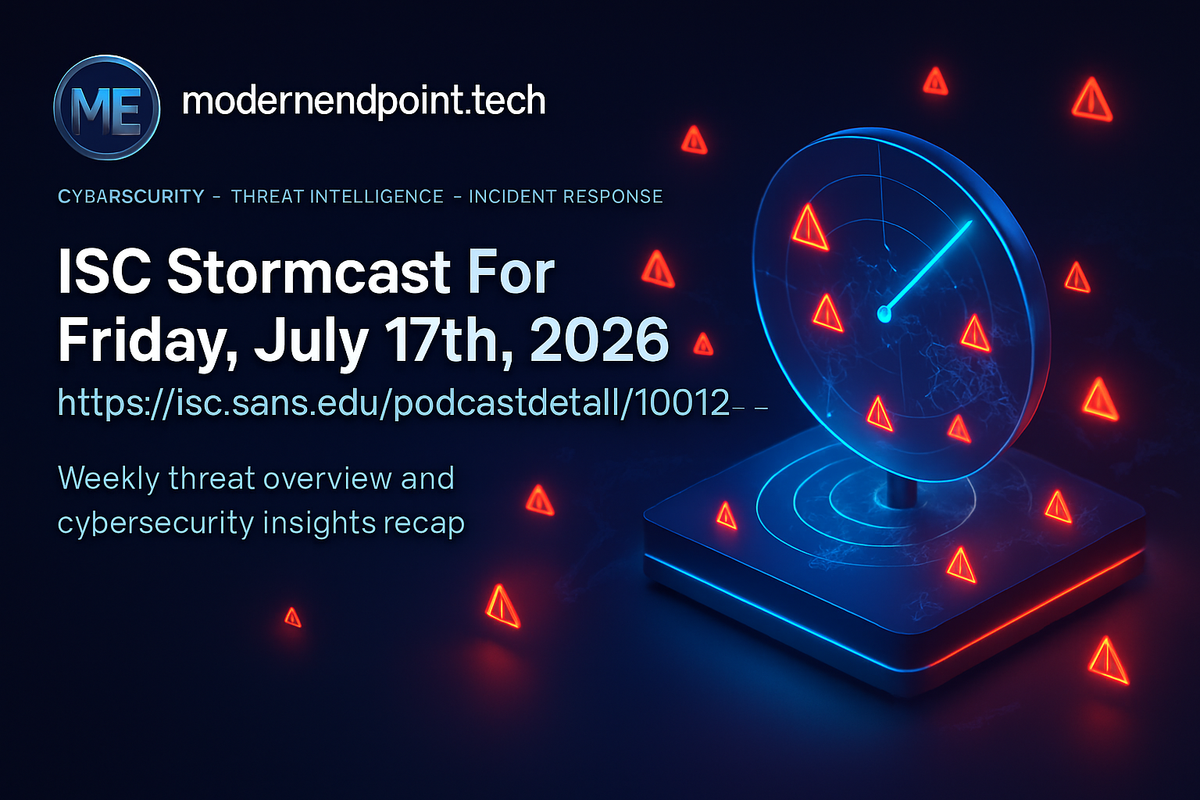
ISC Stormcast For Friday, July 17th, 2026 https://isc.sans.edu/podcastdetail/10012…
In my experience working with enterprise organizations, the frequency of security alerts can overwhelm. SOC teams often drown in a deluge of notifications, each demanding attention yet not all meriting priority. It's no secret that the ability to distinguish critical threats from benign blips could mean the difference between a routine incident and a devastating breach. But why does this problem persist, and what can be done about it?
🔍 The Unseen Complexity of Security Alerts
In my experience working with enterprise organizations, the frequency of security alerts can overwhelm. SOC teams often drown in a deluge of notifications, each demanding attention yet not all meriting priority. It's no secret that the ability to distinguish critical threats from benign blips could mean the difference between a routine incident and a devastating breach. But why does this problem persist, and what can be done about it?
Most enterprises assume that increased alert volumes signal robust security measures. Reality, however, paints a different picture.
Organizations must understand why managing alert noise is not just about fine-tuning systems but rethinking architecture and processes.
⚠️ The Business Challenge: Noise vs. Signal
Too often, enterprises invest heavily in tools like Microsoft Sentinel without establishing a governance framework. The result? Significant operational noise. Alerts pile up, and teams scramble, caught in a reactive stance. The financial cost? Considerable. The operational debt? Alarming. Without clear governance, organizations risk not only false positives but missing the true threats.
Microsoft Sentinel offers powerful detection and response capabilities, assuming it is correctly configured and continuously refined.
🔐 Technology Overview: Sentinel in Context
Microsoft Sentinel is an advanced SIEM (Security Information and Event Management) system within the Microsoft 365 ecosystem. It integrates with other Microsoft tools like Defender for Cloud Apps, Intune, and Entra ID (formerly Azure AD) to provide a consolidated view of your security landscape. Sentinel excels at providing AI-enhanced threat intelligence and automation capabilities—critical in today’s evolving threat landscape.
Make use of Kusto Query Language (KQL) dashboards in Sentinel to customize alerting to prioritize actionable intelligence.
🏗️ Enterprise Architecture: Building for Insight, Not Alerts
The architecture behind Sentinel is vital not just for detection but maximization of security operations efficiency. By aligning Sentinel with the Microsoft Defender XDR suite, security architects can design workflows that prioritize incident response over mere incident detection. This involves refining identity flows through Entra ID for seamless access control.
🚫 What This Technology Does NOT Solve
Sentinel doesn't magically fix all security issues. It doesn’t classify data nor does it replace the need for robust governance models. It’s crucial for organizations to acknowledge that successful Sentinel deployment requires deep integration across business processes—not just IT operations.
🎯 Final Architect Recommendation
If I were advising a client today, I'd highlight the crucial balance between automation and human oversight. Enable Microsoft Sentinel only when your organization is ready to invest in customized rules and governance practices. Do not roll this out directly to production without a phased approach—begin with a focused pilot group for refining alert thresholds and tuning AI models to fit your threat landscape.
🎯 The Takeaway
- Prioritize Customization: Implement Sentinel with tailored rules to minimize operational noise.
- Governance is Key: Develop a robust governance model before full deployment.
- Balance Automation with Insight: Employ AI for scalability but keep critical human oversight.
- Phase Rollout: Test on a pilot group to refine configurations and learn from data-driven adjustments.
- Training and Continuous Improvement: Invest in ongoing training for SOC teams to keep pace with evolving threats.
Each section illustrates the inherent complexities and necessary considerations often overlooked in favor of tool deployment. Ultimately, Sentinel's true value is realized when architecture, governance, and operations mature in unison. Always remember, the technology you deploy today shapes the threat landscape you'll face tomorrow.
![[PREVIEW] Default Azure Automation Setting Enables Cross-Tenant Identity Takeover: What IT…](https://storage.ghost.io/c/18/07/18075d62-c435-4588-bde1-d440868fbdab/content/images/size/w600/2026/07/cover-27.png)