Microsoft Entra ID security updates: Passkeys are the default authentication method

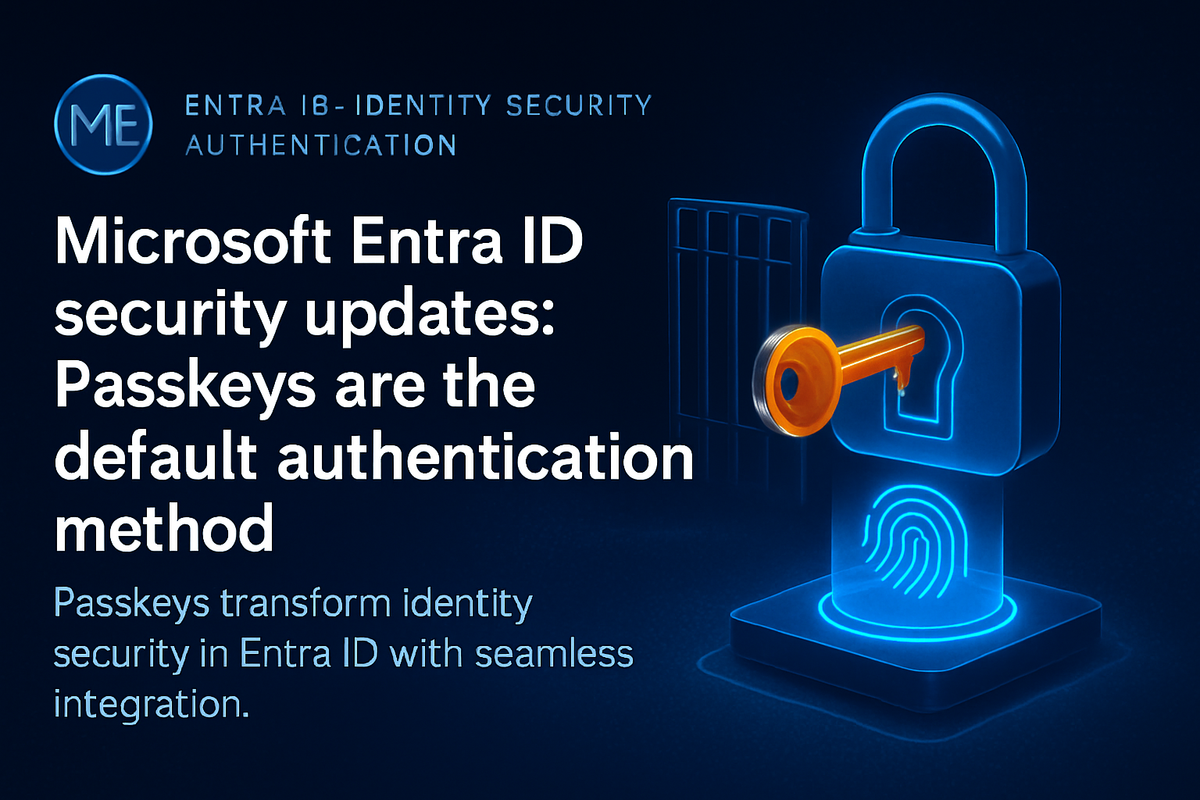
Microsoft Entra ID security updates: Passkeys are the default authentication method
A few months back, I was working with a large global enterprise to streamline their identity management architecture. Despite advanced tools and governance structures, they struggled with user friction. Multi-factor authentication was cumbersome, employee productivity took a hit, and IT helpdesks were overwhelmed with support requests. It's a common story: improving security shouldn't degrade user experience, but it often does. And then came a silver lining — passkeys.
🔍 Field Reality Check
A few months back, I was working with a large global enterprise to streamline their identity management architecture. Despite advanced tools and governance structures, they struggled with user friction. Multi-factor authentication was cumbersome, employee productivity took a hit, and IT helpdesks were overwhelmed with support requests. It's a common story: improving security shouldn't degrade user experience, but it often does. And then came a silver lining — passkeys.
Passkeys promised a seamless yet secure authentication mechanism, and today we see that Microsoft is making them the default for Entra ID. Why does this matter? Because this shift is more than a technical change; it's a governance and compliance milestone. Let's unpack why.
⚠️ The Governance Milestone
Most organizations believe: Governance begins and ends with setting policies.
Reality: True governance means ensuring policies adapt to user behavior and market demands.
Switching passkeys to a default authentication method transcends pure technological advantage. It enhances governance, aligning security with minimal user friction, thus developing sustainable frameworks for compliance. Many enterprises wrestle with compliance across various domains—GDPR, ISO 27001, and more. Default passkeys resonate with these regimes' essence: achieving security without being intrusive.
🔐 Operational Implications
Transition always makes a splash in operations. Moving to a passkey-based model means revisiting process flows, identity proofing, and access lifecycles. I've seen this pattern: operational debt amasses when new technologies aren't fully integrated into existing workflows. It's not merely a matter of pressing a button. Conditional Access architecture needs revisiting to align with this change.
A typical architecture now might look like this:
| Layer | Before Passkeys | With Passkeys |
|---|---|---|
| Authentication | MFA via SMS/Emails | Passkeys as primary |
| Password Policies | Stringent, frequent expiration | Less stringent, longer validity |
| User Management | High password reset traffic | Reduced helpdesk intervention |
| Overall Security | High but cumbersome | High and seamless |
🧩 Conditional Access Architecture
Conditional Access wasn't meant to be static. It's meant to adapt, to evolve. In my experience, when enterprises shift to passkeys, they need to rethink their Conditional Access policies. Adjustments should be made to ensure these policies take advantage of the synched security posture that passkeys introduce.
Not all existing systems will smoothly accommodate passkeys. Some legacy applications might require additional tooling or wrappers to participate in the new authentication processes.
🏗️ Production Challenges
In production, necessity drives innovation. On Day 1, expect initial flux: unforeseen configuration settings, identity conflicts, or passkey drift. By Month 6, policies might need realignment as teams adapt to this new status quo. Year 2 is when the drift should have stabilized, and the system has matured.
💡 Considering the Trade-Offs
Change is inherently risky. Introducing passkeys universally requires a definite cost evaluation. There are trade-offs, and knowing them helps optimize decisions.
🚫 What This Technology Does NOT Solve
Microsoft Entra ID's passkey feature is not a panacea. It won't tackle shadow IT where credentials outside the organization's governance umbrella escape scrutiny. Nor will it solve backend security infrastructure inadequacies.
Moreover, passkeys are not suitable for all scenarios, notably systems without updated browsers or modern authentication frameworks. Enterprises misaligned on cloud-first mindsets can run into friction with legacy environments.
🎯 Final Architect Recommendation
If I were leading an enterprise architecture now, I'd recommend commencing with a pilot program. Begin with departments most aligned with digital transformation strategies. Assess user feedback, and document operational impacts meticulously.
- Governance before deployment: Look at administrative processes and adjust them in parallel as the switch to passkey feature proceeds.
- Multi-layered Conditional Access: Ensure you're capturing the context of access requests effectively — device trust, identity signals, location parameters.
- Stakeholder Education: Your IT teams, employees, and other stakeholders need comprehensive training to adapt seamlessly to this new front.
<span style="font-weight: bold">What breaks first?</span> — Often, it's the integration with niche third-party applications that don't support modern authentication protocols.
<span style="font-weight: bold">When should enterprises deploy?</span> — Early adopters in aligned industries seeking compliance and seamless security for their workforces find value in immediate pilots based on initial readiness.
<span style="font-weight: bold">What are the hidden risks?</span> — Failing to adapt governance processes could erode trust with increased administrative overhead. Without oversight, identity sprawl risks remain, sabotaging security postures.
🎯 The Takeaway
- Selectivity is Key: Begin your migration with select departments to gather initial insights and iteratively extend engagement.
- Governance Alignment: Sync your governance frameworks with passkey benefits. Prudent policy refreshes are crucial.
- Mind the Legacy Gap: Recognize the boundaries of passkeys—anticipate scenarios where they won't bridge legacy gaps.
- Unified Communication: Leverage communication bridges where stakeholders consistently share feedback and evolve architectural insights together.
- Audit and Evolve: Regular identity and security audits aligned with passkey transition will ensure balanced adoption without degraded user experience.
Passkeys in Entra ID shouldn't be seen just as a modern step forward in security. Rather, they represent a paradigm shift in how we engage with and design identity ecosystems. It's not just about entering a passcode or scanning your thumb—it's about reshaping governance to harmonize security and operational soundness. That is where the shift matters most.
![[PREVIEW] Default Azure Automation Setting Enables Cross-Tenant Identity Takeover: What IT…](https://storage.ghost.io/c/18/07/18075d62-c435-4588-bde1-d440868fbdab/content/images/size/w600/2026/07/cover-27.png)