What is coming to Microsoft 365 E5?

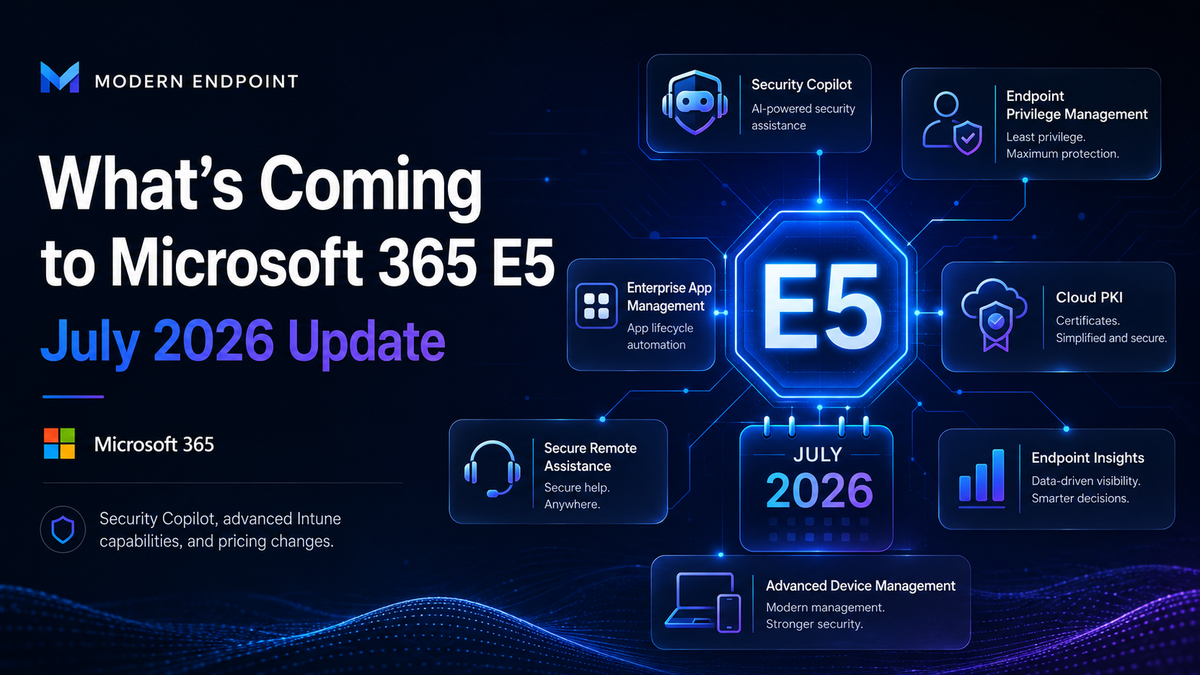
What is coming to Microsoft 365 E5?
Microsoft is adding major security and endpoint-management capabilities to Microsoft 365 E5, including Security Copilot access and advanced Intune Suite capabilities, alongside a pricing update.
Why this change matters
Microsoft is reshaping the value of Microsoft 365 E5 by bundling capabilities that previously required separate licensing. For security and endpoint teams, this is not just a price update — it changes the baseline architecture available to E5 tenants.
The practical impact: organizations that already own Microsoft 365 E5 can start planning for advanced security operations, endpoint privilege control, app lifecycle automation, cloud-based PKI, and improved device analytics as part of the core E5 operating model.
Security Copilot becomes part of E5
AI assistance for security operations
Security Copilot is coming to Microsoft 365 E5 customers, bringing AI-assisted investigation, summarization, triage, natural-language querying, and security workflow support into Microsoft security portals.
per 1,000 users
Security Compute Units are the consumption capacity behind Security Copilot experiences. Microsoft states that E5 customers receive included SCU capacity, with a cap at tenant scale.
Advanced Intune capabilities added to E5
EPM — least privilege by design
Allows standard users to perform approved elevated tasks without making them local administrators.
- Audited privilege elevation
- Approval workflows where required
- Reduced local-admin dependency
- Better governance over privileged actions
EAM — app lifecycle automation
Provides a managed catalog and automated update model for supported third-party applications through Intune.
- Streamlined third-party app updates
- Reduced scripting and packaging overhead
- Improved application lifecycle consistency
- Better patch governance from Intune
Cloud PKI — certificate services without legacy overhead
Enables certificate issuance and lifecycle management from the cloud, reducing dependency on traditional on-premises PKI components.
- Cloud-hosted certificate authority model
- Certificate delivery through Intune
- Useful for Wi-Fi, VPN, and identity scenarios
- Reduces infrastructure complexity
Secure remote assistance
Brings audited remote support capabilities into the Intune management model.
- Role-based support workflows
- Auditable support sessions
- Integrated endpoint support experience
- Reduced dependency on unmanaged remote tools
Deeper endpoint insights
Extends endpoint analytics with additional visibility into device health, reliability, and user experience.
- Device performance insights
- Reliability and anomaly signals
- More informed hardware lifecycle planning
- Better operational reporting
Additional management capabilities
Adds advanced management scenarios such as Microsoft Tunnel and specialty device management.
- Microsoft Tunnel scenarios
- Specialty device management
- Expanded endpoint management options
- Better alignment with enterprise requirements
What changes in pricing?
| Plan | Old price | New price | Increase | Main additions |
|---|---|---|---|---|
Microsoft 365 E5 |
$57.00 | $60.00 / user / month | +5% | Security Copilot capacity + advanced Intune capabilities such as EPM, EAM and Cloud PKI |
Microsoft 365 E3 |
$36.00 | $39.00 / user / month | +8% | Selected advanced Intune capabilities, according to Microsoft packaging updates |
Pricing shown is Microsoft’s published USD list pricing for enterprise suites with Teams. Local market pricing, agreement type, renewal timing, and channel terms may affect the actual customer impact.
Rollout and renewal timing
Microsoft announces the packaging and pricing update
Microsoft publishes the new capability additions and upcoming commercial price changes.
Message Center notice
Microsoft states that customers receive advance Message Center notice before some new capabilities are activated.
Pricing update takes effect
The new list pricing becomes effective from July 1, 2026, with customer impact depending on renewal timing and agreement terms.
Security and endpoint teams should prepare
Organizations should review governance, rollout sequencing, RBAC, monitoring, licensing assignments, and adoption priorities before enabling production use.