From Terminal Servers to Azure

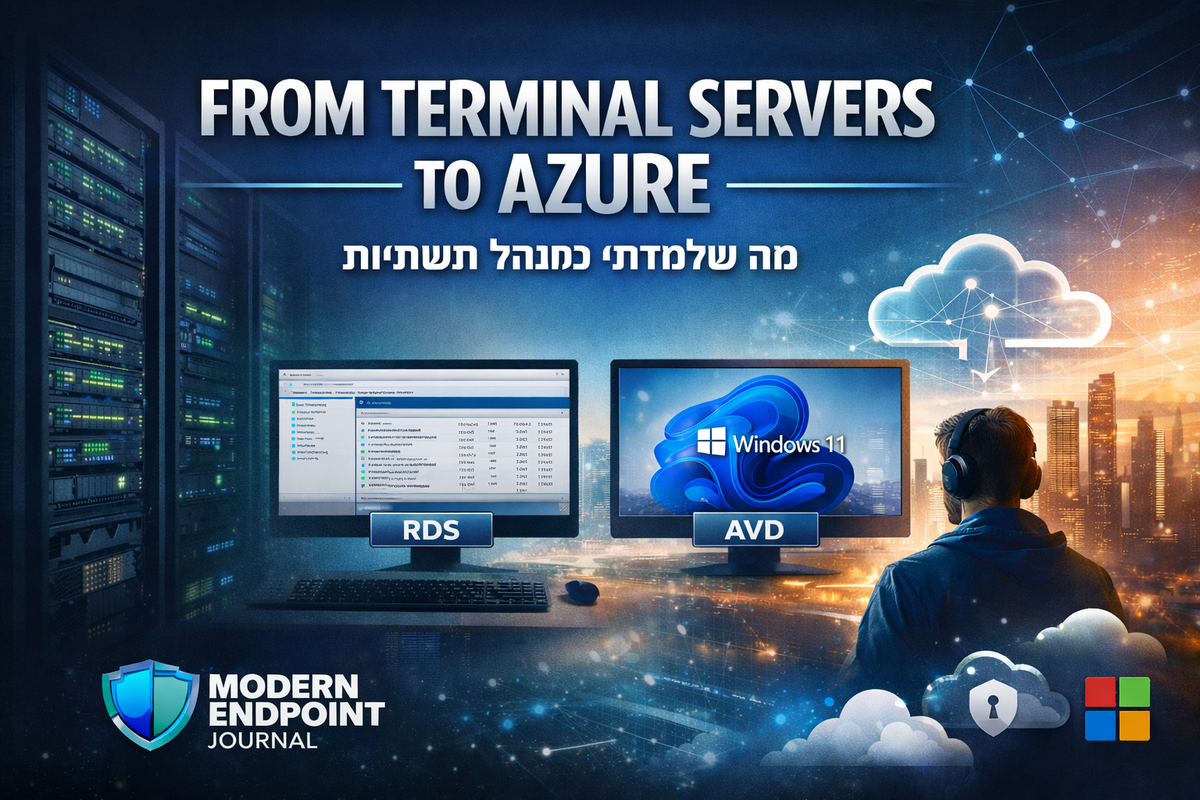
What Changed When I Stopped Managing Servers — and Started Designing Platforms
I'm not writing this as a cloud evangelist.
I'm writing this as someone who managed real RDS farms. Someone who renewed certificates at midnight. Someone who maintained a licensing server. Someone who pushed Patch Tuesday updates and hoped nothing would break the next morning.
This is not theory.
This is field experience.
Life with RDS — The Part No One Puts in the Slide Deck
On paper, Remote Desktop Services looked solid. In reality, the architecture looked different.
On Paper
- Centralized management
- High availability
- Session collections
- Gateway access
In Reality
- Session Hosts
- Connection Broker
- RD Gateway
- Licensing Server
- Windows Server CALs
- RDS CALs
- Certificate renewals
- GPO conflicts
- CPU spikes
- Profile corruption
- Session overload
Every new employee required manual steps. Every infrastructure change carried risk. Every expansion required hardware planning.
And the most common user question?
"Why doesn't this feel like my computer?"
Because it wasn't. It was a shared server.
The Cost No One Calculates Properly
RDS is rarely just "a server." You need:
- Windows Server CALs
- RDS CALs (Per User or Per Device)
- A Licensing Server
- Ongoing compliance tracking
- Version compatibility validation
Then add:
- Virtual machines or physical hosts
- Storage
- Backup
- Disaster recovery
- Hardware refresh cycles
- Operational overhead
The real cost was never just licensing. It was operational fatigue. It was reactive work. It was burnout.
Then Azure Virtual Desktop Changed the Conversation
The first time I deployed an Azure Virtual Desktop host pool and realized I no longer had to maintain a broker — that was the shift.
- No RD Gateway to manage
- No inbound firewall exposure
- No licensing server
- No RDS CAL tracking
Microsoft manages the control plane. We manage the workload.
That is not a feature improvement. It is a structural difference.
The Licensing Reality Most Organizations Overlook
Most modern organizations already run:
- Microsoft 365 Business Premium
- E3
- E5
With eligible licensing, AVD access rights are included.
- No separate RDS CAL procurement
- No per-device licensing complexity
- No scaling procurement cycle
You pay for compute and storage. That simplifies: budgeting, scaling, and governance.
The Real Breakthrough: AVD + Intune
This is where it stops being "VDI" and becomes modern endpoint architecture.
With AVD integrated into Intune:
- Win32 app deployment becomes structured
- Update rings are controlled
- Compliance policies are enforced
- Defender integrates natively
- Device governance becomes identity-driven
Move further: MSIX App Attach.
Separate applications from the golden image. Reduce image bloat. Accelerate change. Lower operational risk.
In the RDS world, application deployment meant logging into production servers. Manually. Every time.
Security: Network-Based vs Identity-Based
RDS Model
- VPN
- Firewall rules
- Network segmentation
Question: What port is open?
AVD Model
- Conditional Access
- MFA enforcement
- Device compliance
- Zero Trust principles
Question: Who is accessing, from what device, under what conditions?
That is architectural maturity.
Operationally, Everything Changes
RDS Era
- Resetting sessions
- Troubleshooting brokers
- Renewing certificates
- Debugging licensing
AVD Era
- Architecture
- Automation
- Cost optimization
- Scaling strategy
- Security posture
That is the difference between surviving and leading.
When RDS Still Makes Sense
To be fair: RDS remains relevant when:
- Cloud connectivity is not permitted
- Regulations prohibit cloud services
- Infrastructure must remain isolated
- Microsoft 365 licensing is absent
But in most modern organizations, AVD aligns better with how identity, security and device management have evolved.
The Personal Shift
Before
- I sent users a server address
- I explained how to launch mstsc
- I warned them not to log off incorrectly
- I hoped performance would hold
Today
- They sign in with their organizational identity
- They open their workspace
- They click
- They work
- They don't even realize they are on a session host
And that is the point.
Lessons from the Field
RDS taught me how to keep systems alive.
AVD allowed me to design systems properly.
RDS forced reactive infrastructure management.
AVD enabled strategic platform engineering.
The difference is not only technical. It is philosophical.
It is the difference between managing servers
and designing experiences.
The technology is powerful. But what matters is the mindset: stop asking "How do we manage this?" and start asking "How do we design this?"
Part of the Modern Endpoint Governance Series
Lifecycle governance is not an operational detail — it is an architectural responsibility.
This article strengthens the structured operating model defined within the series.
Explore the full governance framework:
https://www.modernendpoint.tech/modern-endpoint-governance-series/