Data Security Governance Builder

Data Security Governance Builder
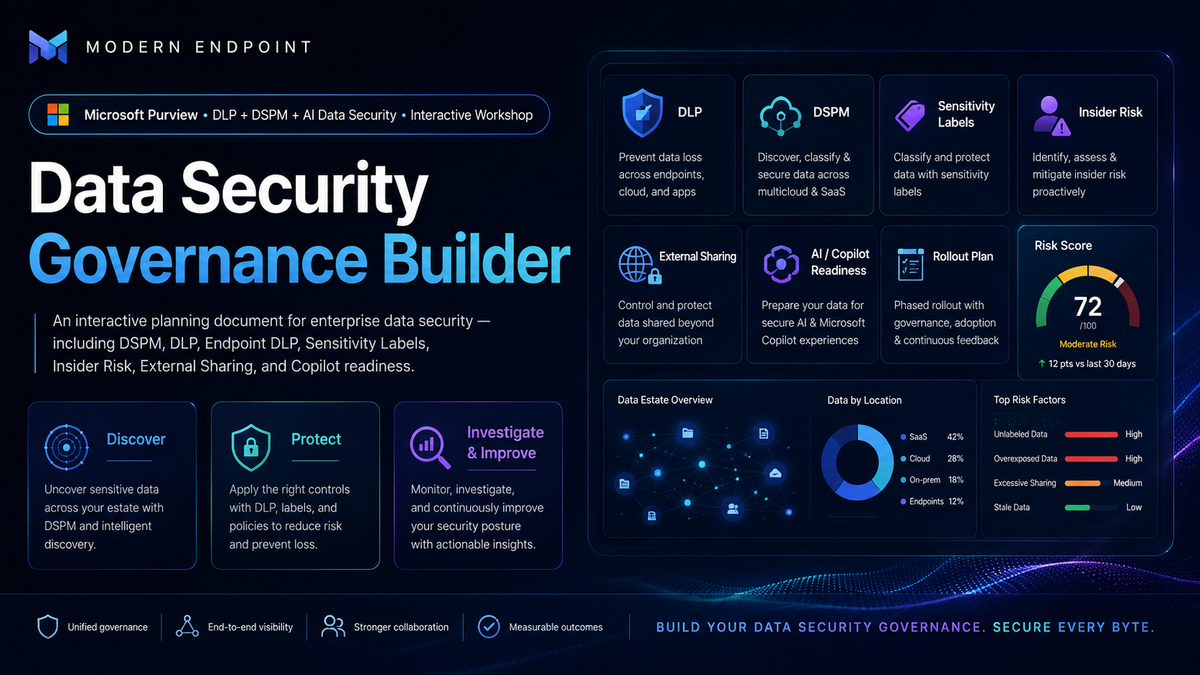
An interactive planning document for enterprise data security: DSPM, DLP, Endpoint DLP, Sensitivity Labels, Insider Risk, External Sharing and Copilot readiness — including a live builder that generates recommendations, risk score, policy names, rollout plan and executive summary.
Discover
Identify where sensitive data resides, who can access it, where it is shared, and where overexposure exists.
Protect
Connect labels, DLP, endpoint controls, external sharing governance and an exception process.
Investigate & Improve
Operationalize investigation, remediation, insider risk signals, KPI and monthly governance review.
What are we building?
This is not just a DLP policy builder. It is a complete Data Security Governance workshop template. It starts with DSPM to understand data risk, continues with information protection to classify and protect data, and then applies DLP to control data movement and sensitive data usage.
The recommended approach is visibility before enforcement. Broad blocking without context creates noise, false positives, business friction and loss of user trust.
When to use it
Use it before a DLP project, before a Copilot rollout, after a data exposure incident, as part of ISO/SOC 2/GDPR readiness, or when a customer says: “We have labels, but data is still exposed.”
Recommended Data Security Architecture
Data Discovery & DSPM
Map sensitive data, overexposed data, external sharing, stale permissions, AI exposure and high-risk users.
Classification & Labeling
Define sensitivity labels, auto-labeling, container labels, encryption, visual marking and label adoption metrics.
DLP Control Plane
Create policies for Exchange, SharePoint, OneDrive, Teams, Endpoint, browser upload, USB, print, clipboard and cloud apps.
Insider Risk & Investigation
Connect alerts, user risk signals, high-severity DLP events, evidence collection and case management.
Governance Operations
Define owners, exceptions, monthly tuning, KPI, SIEM/XDR integration and legal/compliance/security review.
DLP vs. DSPM
| Capability | Role |
|---|---|
| DSPM | Discovers and prioritizes risk: where sensitive data is exposed, who can access it, and what should be remediated first. |
| DLP | Controls actions during use or sharing: email, files, endpoint activity, Teams messages and more. |
| Labels | Classify and optionally encrypt data, enabling consistent policy decisions across workloads. |
| Insider Risk | Investigates risky user behavior patterns and connects data events into case workflows. |
Core principle
Discover → Classify → Coach → Enforce → Govern
The goal is not to block users. The goal is to reduce data exposure while preserving legitimate business processes.
What is DSPM?
Data Security Posture Management helps the organization understand its data exposure posture. It looks for sensitive data, excessive access, external exposure, risky sharing paths, stale permissions, and AI-related exposure before enforcement is applied.
DSPM should answer: Where is sensitive data? Who has access? Is the access justified? Is it shared externally? Could AI surface it to users who should not see it? Which issues should be fixed first?
DSPM output
- Risk register
- Overexposed sensitive data
- External sharing findings
- Priority remediation list
- Copilot readiness gaps
- Data owner mapping
DSPM workflow
Inventory
Discover sensitive data across SharePoint, OneDrive, Exchange, Teams and endpoints where applicable.
Exposure Analysis
Identify broad access groups, guest access, anonymous links, external domains and stale permissions.
Business Context
Map data owners, business processes, allowed external collaboration and exception requirements.
Prioritized Remediation
Fix critical issues first: secrets exposure, regulated data externally shared, HR/Legal sites with broad permissions, and AI-exposed sensitive data.
Policy Design
Translate validated risks into labels, DLP rules, endpoint controls, insider risk policies and governance review cadence.
DSPM risk patterns
- Oversharing with Everyone / broad groups
- External sharing of sensitive files
- Guest users with stale access
- Unlabeled sensitive documents
- Credentials, secrets and API keys in files
- Copilot/AI exposure due to excessive access
- Privileged users accessing sensitive content
DSPM to DLP translation
DSPM tells you what is risky. DLP decides what happens when users try to move, share, upload, print or copy sensitive data.
Interactive Builder
Recommended Output
Recommended policy / workstream name
Intent statement
Recommended controls
Rollout plan
Customer talking points
Workshop-ready scenarios
| Scenario | Risk | What to check in DSPM | Recommended controls | Recommended start |
|---|---|---|---|---|
| PII sent by email to an external recipient | Regulatory data leakage | Top senders, external domains, recurring patterns | Exchange DLP, policy tip, override, alerting | Audit → Notify |
| HR files shared broadly in SharePoint | Internal oversharing | Broad groups, Everyone links, stale permissions | Access review, Confidential HR label, SharePoint DLP | DSPM cleanup before block |
| Secrets/API keys found in documents or code exports | Credential leakage | Locations, owners, exposure, external sharing | High-confidence DLP, developer education, block after pilot | Short audit → Block |
| Sensitive file uploaded to personal web storage | Endpoint exfiltration | Device/user scope and browser destinations | Endpoint DLP browser upload controls and domain groups | Limited pilot |
| Copy to USB or print of sensitive files | Data removal | Departments and legitimate business exceptions | Endpoint DLP USB/Print/Clipboard controls | Audit → Warn → Block by group |
| Copilot surfaces sensitive content because permissions are broad | AI exposure | Sensitive sites, broad access, external users | DSPM, permission cleanup, labels, DLP | Remediate permissions before rollout |
| Teams messages include sensitive data | Uncontrolled chat sharing | Data types, volume and users | Teams DLP and user coaching | Notify before restrict |
| Finance shares reports with vendors | Legitimate business process with data risk | Allowed domains and recurring vendors | Allow list, override justification, encryption/labels | Notify + Override |
| Guest users access classified files | External access exposure | Guest access, shared sites, label coverage | External sharing governance, labels, access reviews | DSPM cleanup |
| User downloads an abnormal volume of sensitive files | Insider risk | Anomalous downloads, DLP alerts, user context | Insider Risk, high-severity DLP, case workflow | Investigate |
90-Day Roadmap
Discovery
Enable DSPM views, inventory sensitive data, identify oversharing, map top risks.
Baseline
Define labels, sensitive information types, owners, naming, alert routing and exception process.
Pilot
Run DLP in test mode for 2–3 scenarios and small user groups.
Notify
Enable policy tips, user coaching, business justification and reporting.
Restrict
Limit external sharing, block high-confidence secrets, pilot endpoint controls.
Operate
Monthly governance, tuning, KPI, insider risk linkage and SIEM/XDR integration.
Implementation by maturity level
| Maturity level | Typical state | Do first | Do not do yet |
|---|---|---|---|
| Level 1 — Visibility | No reliable view of sensitive data | DSPM, audit, inventory, top risks | Do not broadly block |
| Level 2 — Classification | Labels are partial or inconsistent | Label taxonomy, auto-label pilot | Do not encrypt everything |
| Level 3 — Guided Protection | Basic labels and DLP exist | Policy tips, override, exceptions | Do not tighten without metrics |
| Level 4 — Enforcement | Scenarios are clear and measured | Restrict/block by risk | Do not enforce without a business owner |
| Level 5 — Continuous Governance | Operational cadence exists | KPI, reviews, SIEM/XDR, insider risk | Do not leave policies without tuning |
Decision matrix: risk to control
| Risk Pattern | DSPM Action | Label Action | DLP Action | Endpoint / Insider |
|---|---|---|---|---|
| Oversharing | Find broad permissions and external links | Confidential label for content/sites | Restrict external sharing | Insider only if anomalous behavior exists |
| Credential leakage | Find secrets across stores | Optional, usually secondary | High-confidence block | Alert SOC immediately |
| Regulated data | Map storage and access | Auto-label with confidence | Notify/override/restrict | Case management for severe alerts |
| AI exposure | Identify sensitive data available to broad audiences | Label and protect | DLP where sharing/action risk exists | Investigate unusual AI interactions where available |
| Endpoint exfiltration | Identify users, devices and data types | Required for robust control | Endpoint DLP | USB/Print/Clipboard/Browser upload |
Naming Convention
Recommended KPI
- Number of sensitive items discovered
- Overexposed sensitive files
- DLP alerts by severity
- False-positive rate
- Override rate and justifications
- Top users / departments / locations
- Time to remediate external sharing
- Label coverage and unlabeled sensitive content
Production Readiness Checklist
Executive Summary Template
Workshop questions for the customer
- Which data would create the biggest risk if it leaked?
- Where does this data live today?
- Who is the business owner?
- Which external sharing flows are legitimate?
- What is the tolerance for false positives?
- Is Copilot already enabled or planned?
- Who handles alerts and what is the SLA?
Customer deliverables
- Data Security Risk Register
- DLP & DSPM Architecture Plan
- Policy Naming Standard
- Pilot Plan
- Exception Process
- Monthly Governance Report
- Copilot Readiness Findings
- Operational Runbook